
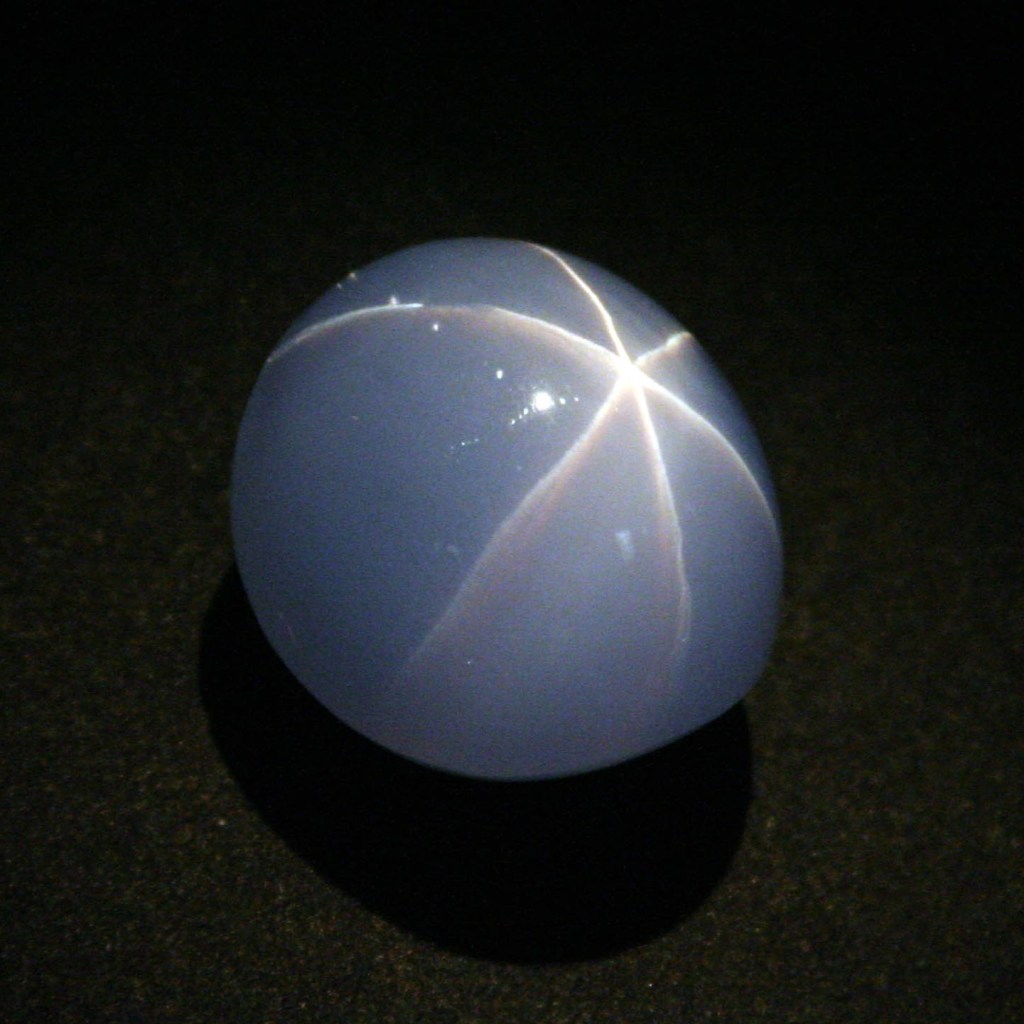
The asteria, or star sapphire, might be called a “Stone of Destiny” as the three crossbars which traverse it are believed to represent Faith, Hope, and Destiny. As the stone is moved, or the light changes, a living star appears. As a guiding gem, warding off ill omen and the Evil Eye, the star sapphire is worn. One of the most unique talismanic stones, it is said to be so potent that it continues to exercise its good influence over the first wearer even when it has passed into other hands.
Sir Richard Burton’s Star Sapphire: The Victory Stone
George Frederick Kunz (d. 1932), mineralogist and great gemologist at Tiffany’s, wrote of the “great oriental traveler Sir Richard Francis Burton.” Burton (d.1890) was a British explorer, writer, orientalist scholar, and soldier. He was famed for his travels and explorations in Asia, Africa, and the Americas, as well as his extraordinary knowledge of languages and cultures. According to one count, he spoke twenty-nine languages. Burton’s best-known achievements include: a well-documented journey to Mecca in disguise, at a time when non-Muslims were forbidden access on pain of death; an unexpurgated translation of One Thousand and One Nights and the publication of the Kama Sutra in English.
Kunz writes: “Burton had a large star sapphire, or asteria as he called it, that he referred to as his talisman, for it always brought him good horses and prompt attention wherever he went. In fact, it was only in those places where he received proper attention that he would show it to the natives, a favor they greatly appreciated, because the sight of the stone was believed to bring good luck. The fame of Burton’s asteria travelled ahead of him, and it served him well as a guiding-star.”
In the seventeenth century, Germans referred to such a stone as siegstein meaning “victory-stone”.
The Many Wanderings of the Star of India
The remarkable asteria, known as the Star of India in the Morgan-Tiffany Collection in the American Museum of Natural History, has an indefinite historic record of some three centuries, but after its many wanderings it has now found a worthy resting-place in the great Museum. Its weight is 543 carats.
On October 29, 1964, the famous golf-ball-sized stone was stolen, along with several other gems of note. The thieves unlocked a bathroom window during museum open hours, climbed in that night, and found that the sapphire was the only gem in the collection protected by an alarm—and the battery for that was dead. The stones stolen were valued at more than $400,000. Within two days the culprits were arrested: Jack Roland Murphy (also known as “Murph the Surf”), Allan Kuhn, and Roger Clark; however, the gems had already been handed off. In January 1965, in a bid for leniency, Kuhn led authorities to a bus locker in Miami where the uninsured Star of India and some of the other stolen stones were recovered.

 Flora Jewels
