
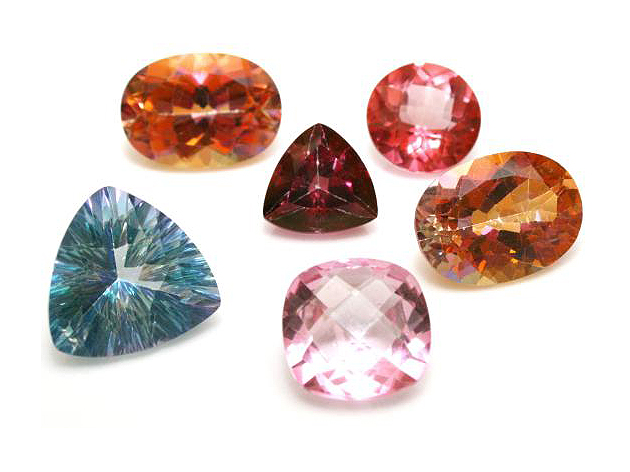
Topaz is a silicate mineral of aluminum and fluorine with the chemical formula Al2SiO4(F,OH)2. Topaz in its natural state is colorless, though trace elements can make it pale blue, golden brown, yellow, or orange. Topaz is often treated with heat or radiation to make it a deep blue, reddish-orange, pale green, pink, or purple. Imperial topaz is yellow, pink, or pink-orange. Brazilian imperial topaz can often have a bright yellow to deep golden-brown hue, sometimes even violet.
Topaz vs. Citrine
Topaz often appears yellow and is sometimes confused with citrine, a less valuable gemstone. The topaz, however, is considerably heavier than citrine, about 25% heavier, and this difference in weight can be used to distinguish two stones of equal volume. Topaz also takes an exceptionally fine polish, and can sometimes be distinguished from citrine by its slippery feel alone.
Both Hard and Weak
Although very hard, measuring an 8 on the Mohs hardness scale, topaz must be treated with greater care than some other hard minerals such as ruby, which measures a 9 on the Mohs hardness scale, due to a weakness of molecular bonding along one axial plane, which gives topaz a tendency to break along a cleavage plane if struck with sufficient force. Diamonds, for example, are much stronger than topaz not only due to their hardness of 10 on the Mohs hardness scale, but also because diamonds are composed of carbon atoms bonded to each other with equal strength along all of its planes.
Brazilian Topaz
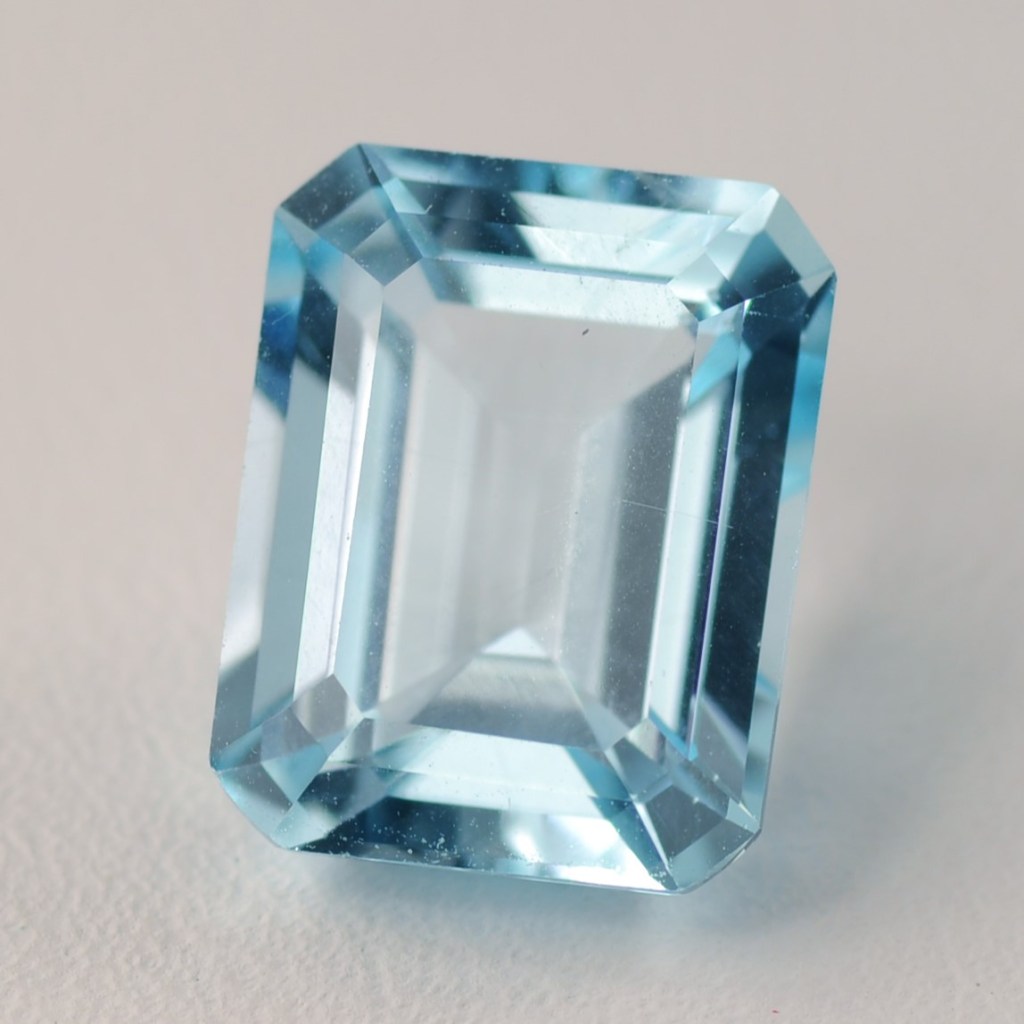
Brazil is one of the largest producers of topaz, but large, vivid blue topaz specimens from the St. Anns mine in Zimbabwe were found in the late 1980s.
Hindu Topaz
The Kalpavriksha or Kalpa Tree is a wish-fulfilling divine tree in Indian religions, like Hinduism, thought of as a symbolic offering to the gods and described by Hindu poets as a glowing mass of precious stones. Pearls hung from its boughs, its foliage was entirely formed of zircons, and beautiful emeralds grew from its shoots. The tender young leaves were corals, and the ripe fruit consisted of rubies. The roots were of sapphire; the base of the trunk of diamond, the canopy of cat’s-eye, and the section between the trunk and the canopy was of topaz.
Jewish Pitdah
The second place on the Jewish High Priest’s Breastplate was also thought of as topaz or topazius, in Latin. Ancient Hebrew writers called this second position pitdah, which seems to have been derived from the Sanskrit word pita, meaning “yellow” and signifying a yellow stone, perhaps topaz, perhaps an Egyptian yellow jasper. On this second stone was engraved the name Simeon.
Roman Topazius
The topaz of ancient writers was most certainly the peridot (also called chrysolite or olivine). Pliny explains that the topaz of his time was found on an island in the Red Sea called Topazios, which derived its name from the word topazein meaning “to conjecture” because the island was notoriously difficult to find. The ancient Romans believed that topaz provided protection from danger while traveling
Topaz of the Middle Ages
In the Middle Ages, the word topaz was used to refer to any yellow gemstone. An English superstition held that topaz cured lunacy and increased mental powers. It was also believed that attaching a topaz to the left arm protected the owner from any curse, warded off the evil eye, and increased body heat, which helped to relieve a cold or fever.
Birthstones and Symbols
Orange topaz, also known as precious topaz or imperial topaz, is the conventional birthstone for November, the symbol of friendship, and the state gemstone of the US state of Utah. Blue topaz is the state gemstone of the US state of Texas.

 Flora Jewels
