

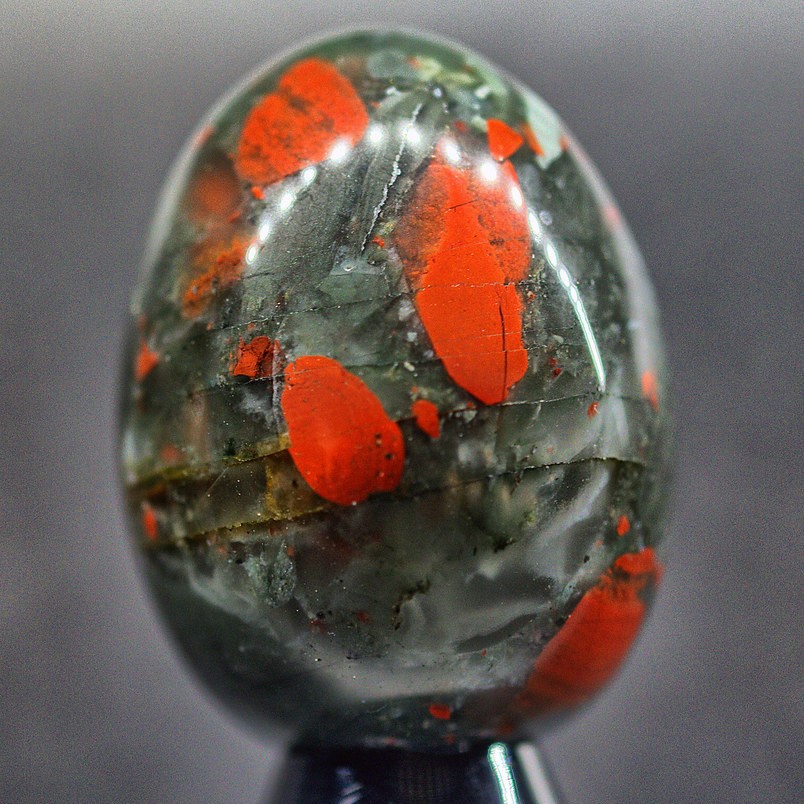
Historic birthstone for March
Bloodstone is a kind of deep green jasper that is speckled with bright red spots of iron oxide. Before 1800 bloodstone was the birthstone of choice for March.
A magical gemstone
Bloodstone was considered very magical. It caused thunder and lightning storms and invisibility. It stopped bleeding and made one’s words so powerful that even kings had to listen.
Confusing challenges arise
But there are some confusing challenges that arise when studying the history of bloodstone. First of all bloodstone was sometimes confused with a completely different gemstone called hematite.
Bloodstone was also referred to as plasma and as heliotrope. Heliotrope was also the name of a kind of flower, and the properties of the gemstone and the flower were comingled and confused over time. To add to the confusion, the purple-flowered heliotrope of Greek times was later thought to be sunflower!
Legend of Orpheus
Orpheus, a poet and historian of the 4th century BC, wrote of the power of bloodstone in his epic of legendary Greek thought called Lithica:
Now, if a heliotrope is put in a silver basin full of water and placed against the sun, it makes it as if bloody and cloudy. The air becomes cloudy with thunder and lightning and rain and hail stones, so that even those experienced in the power of the stone are frightened and perturbed. Such divine power does this stone have.
The sun turner
The Greeks called bloodstone heliotrope, which means “sun turner.” It was thought that when a bloodstone was placed in a silver bowl of water and the sun shone upon the water, rays of the sun would make bright red reflections.
Audible oracles
The bloodstone would cause wind, thunder, and lightning, and the sun itself would turn blood red. The thunder was thought to be an “audible oracle” of the bloodstone, which the prophets would interpret.
Stone of invisibility
Later during the Middle Ages, it was thought that if the juice of the heliotrope flower were rubbed on a bloodstone, then it would make the wearer invisible!
Dante (1265-1321) alludes to this property of heliotrope in his Divine Comedy:
Among this cruel and most dismal throng
People were running naked and affrighted,
Without the hope of hiding hole or heliotrope.
Dante’s Divine Comedy translated by Henry Wadsworth Longfellow (1888)

 Flora Jewels